
Carpet steam cleaning vs. Dry cleaning – Which is right for your home?
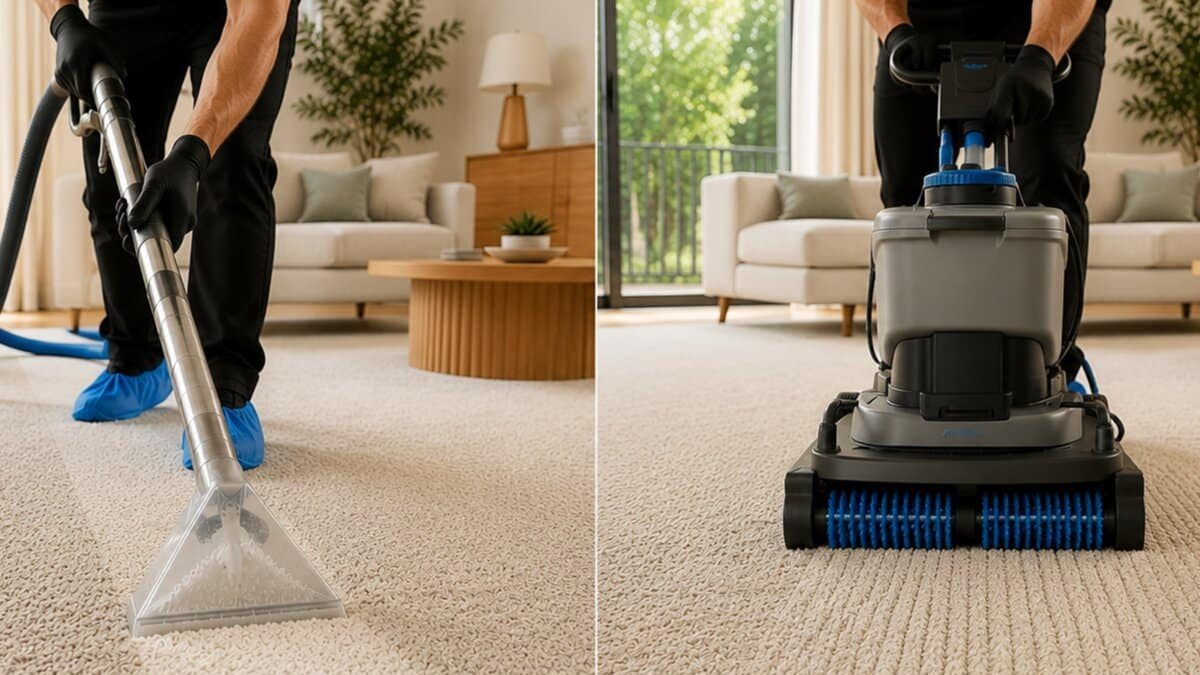
For most Australian homes, hot water extraction (steam cleaning) is the right choice. It cleans deep into the carpet backing, significantly reduces allergens and bacteria, and produces the receipt most property managers ask for at end of lease. Dry cleaning is the correct answer for wool and delicate natural-fibre carpets, and for situations where fast drying is non-negotiable. This guide explains exactly how each method works and which one your situation actually calls for.
Steam cleaning (HWE)
- Deep-cleans and reduces allergens & bacteria
- Penetrates to the carpet backing
- The receipt most agents ask for
- Best for pets, allergies, heavy soiling
- Drying: 3–6 hrs synthetic / 4–8 hrs wool
Dry cleaning (Encapsulation)
- Walk-on ready in 30–60 minutes
- Correct choice for wool & delicate fibres
- Good for light maintenance cleans
- Surface refresh, not deep extraction
- Not sufficient for heavy soiling or pet odour
First – the “steam cleaning” naming myth
“Steam cleaning” is technically a misnomer. True steam — water vapour at 100°C or above — would instantly damage carpet fibres, cause dyes to bleed, and risk burns. What professionals actually use is hot water extraction (HWE): heated water at 60–90°C injected under controlled pressure (typically 400–600 PSI), then immediately extracted at high suction. The IICRC S100 standard, carpet manufacturers’ care guides, and the Australian Carpet Cleaning Institute (ACCI) all refer to this process as hot water extraction.
Throughout this guide, the terms “steam cleaning” and “hot water extraction (HWE)” refer to the same professional process. When you see either term on a quote, a receipt, or a service listing, they describe the same equipment and the same result. Understanding the distinction also matters for end-of-lease: if your property manager’s lease clause says “steam cleaning”, a receipt reading “hot water extraction” describes the same process — the two terms are generally treated as interchangeable.
How hot water extraction (steam cleaning) works
Hot water extraction is a seven-step process. Each step serves a specific purpose — skipping or shortening any of them is why hire machines and DIY attempts don’t produce the same result as professional equipment and training.
1. Pre-inspection
The technician identifies the carpet fibre type (synthetic, wool, or blend), checks for pre-existing stains, notes areas of heavy soiling, and confirms the appropriate cleaning solution chemistry. This step determines everything that follows.
2. Deep pre-vacuuming
An industrial HEPA vacuum removes loose soil, dust, and debris before any moisture is introduced. Skipping this step turns dry soil into a muddy slurry that embeds deeper into the pile when wet cleaning begins.
3. Pre-spray application
An alkaline cleaning solution is applied across the whole area to break down the bonds between soil and carpet fibre. The solution dwells for 5–10 minutes, loosening compacted soil and beginning the emulsification of oils and greases. pH-matched to the fibre type, never alkaline on wool.
4. Stain and high-traffic pre-treatment
Individual stains are treated with specific spotters matched to the chemistry of the stain — protein-based stains (blood, urine) need different treatment to tannin-based stains (coffee, wine). Pre-treatment significantly increases removal rates before the main extraction pass begins.
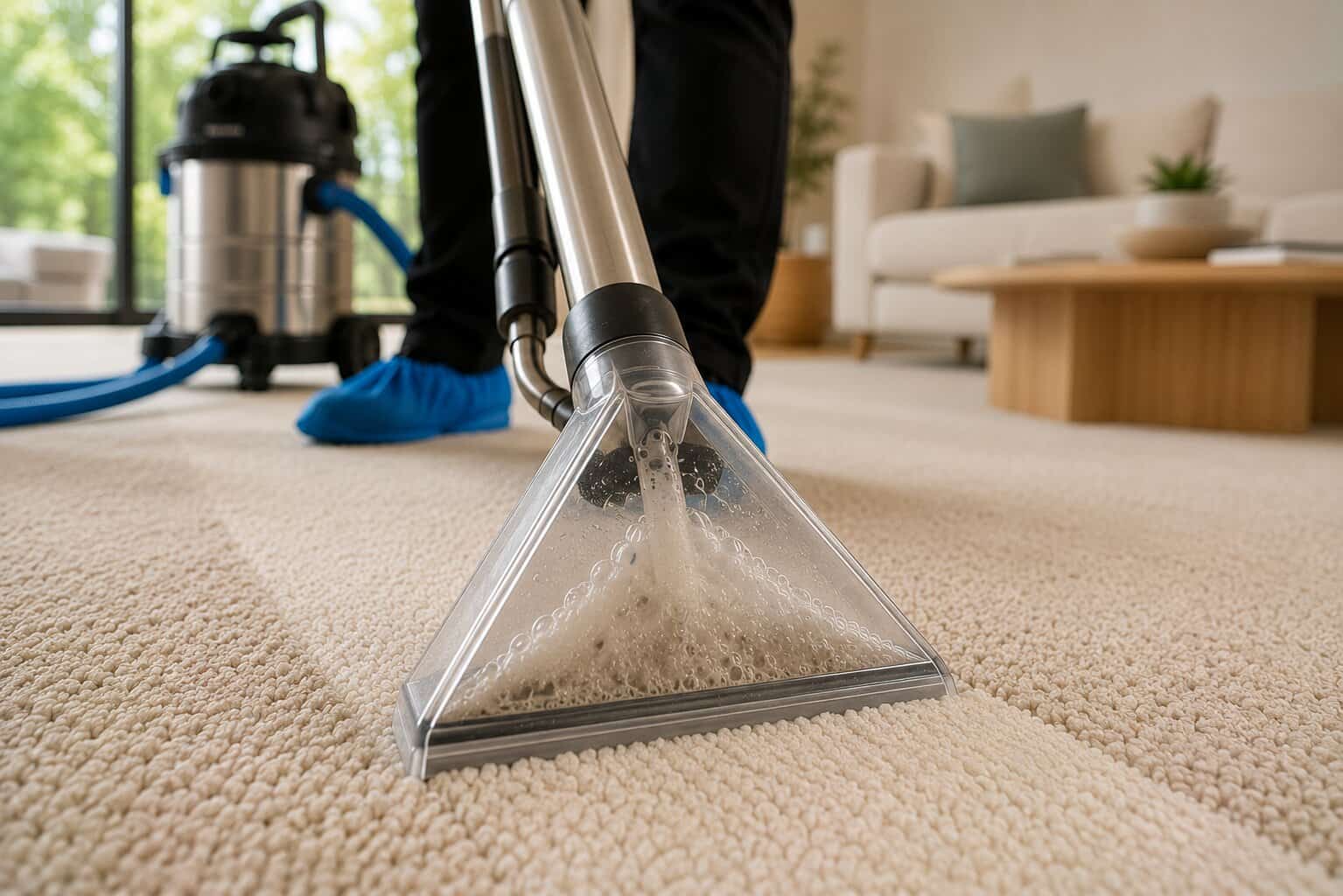
5. Hot water injection and extraction
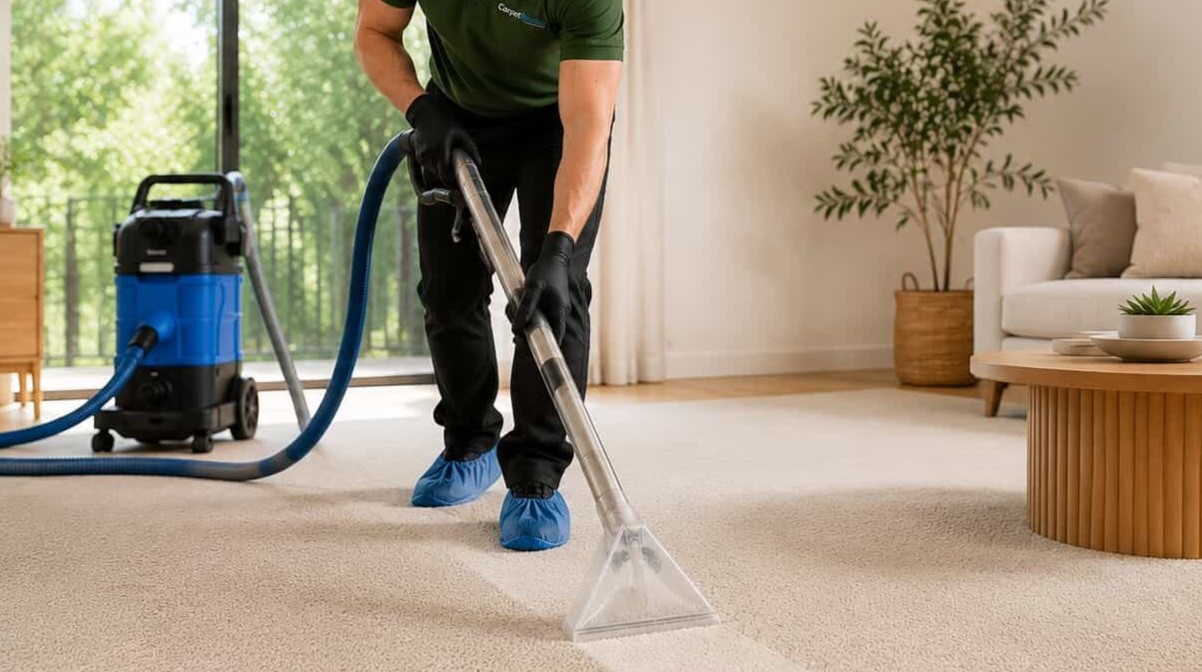
The extraction wand injects water at 60–90°C under controlled pressure, flushing through the carpet fibres and into the backing. Simultaneously, a high-powered vacuum extracts the water along with dissolved soil, allergens, bacteria and cleaning solution, removing the vast majority of moisture in the same pass. Correctly performed, HWE dramatically reduces the allergens and bacteria held deep in carpet fibres.
6. pH-balancing rinse
A mild citric acid-based neutraliser is applied to return the carpet’s pH to approximately 7.0 (neutral). This critical step prevents rapid re-soiling — residual alkaline solution left in carpet fibres attracts new soil much faster, which is why professionally cleaned carpets stay cleaner for longer than DIY results.
7. Pile grooming
A carpet rake is drawn through the pile to realign the fibres in a uniform direction. This speeds drying, restores the carpet’s original texture, and improves the visual result after the carpet dries.
This is the process used for steam carpet cleaning in Melbourne, Sydney and Perth
How dry cleaning (encapsulation) works
Professional dry cleaning for carpets uses an encapsulation process, not the chemical solvents associated with garment dry cleaning. The name reflects minimal water use, not zero chemistry. Here is exactly how it works.
1. Pre-inspection
The technician confirms the fibre type and assesses the soiling level. Encapsulation is not appropriate for heavily soiled carpets or those with deeply set stains — these require HWE first. On wool, the technician checks moisture sensitivity and selects a pH-neutral encapsulation formula.
2. Pre-vacuuming
Same as HWE: removing loose soil first is critical. A powerhead vacuum that agitates the fibres is preferred, loosening compacted debris before the encapsulation solution is applied.
3. Encapsulation solution application
A polymer-based cleaning solution is sprayed across the carpet. The solution contains acrylic co-polymers developed specifically to surround soil particles. Unlike older solvent-based products that left tacky residues, modern encapsulation solutions dry to a brittle, non-sticky crystal.
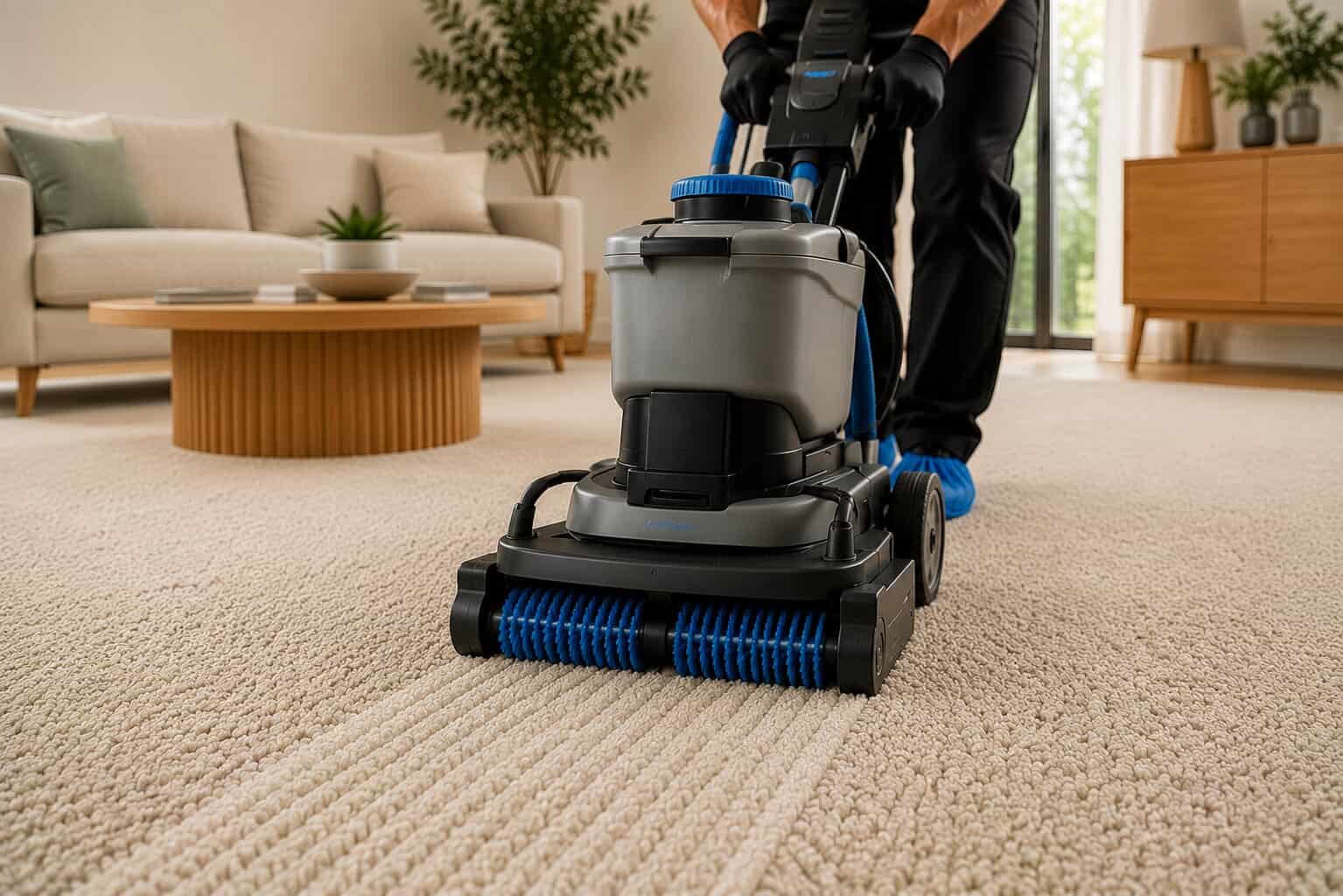
4. Rotary agitation
A counter-rotating brush machine works the solution into the carpet pile, physically breaking soil away from fibres and ensuring the polymer solution encapsulates every particle. The agitation also lifts the pile, which improves the visual appearance. Extra care is taken on loop-pile and Berber construction. Aggressive brushing can snag and pull loops.
5. Crystallisation
As the solution dries, the polymers crystallise around each soil particle, forming brittle shells. This process takes 20–45 minutes. The carpet can be walked on once the surface is dry to the touch — typically 30–60 minutes after treatment — making this the primary advantage over HWE for situations requiring immediate access.
6. Post-vacuum extraction
Once the crystals have formed, a thorough vacuuming removes them, along with the encapsulated soil. The carpet is now refreshed and ready for use. For maximum soil removal, a second post-vacuum pass after 24 hours (once any remaining residue has fully crystallised) is recommended.
This is the process used for dry carpet cleaning in Melbourne, Sydney and Perth
Head-to-head – steam cleaning vs dry cleaning
The table below compares both methods across every dimension that matters for an Australian homeowner. Use it to identify which method your specific situation needs.
| Category | 💧 Steam Cleaning (HWE) Deep clean with hot water extraction |
🌬️ Dry Cleaning (Encapsulation) Low-moisture maintenance cleaning |
|---|---|---|
| Cleaning depth | ✓ Deep — penetrates to the carpet backing | ~ Surface–mid pile only — does not reach backing |
| Allergen removal | ✓ High — deep extraction reaches the pile where allergens accumulate | ~ Surface allergens only — not deep pile |
| Bacteria removal | ✓ High – heat at 60–90°C disrupts bacteria and dust mite lifecycle | ~ Moderate – no heat, limited penetration |
| Heavy stain removal | ✓ Effective with targeted pre-treatment | ✗ Limited – can seal set stains into fibre if applied over them |
| Pet urine & odour | ✓ Effective — flushes urine from backing; combine with enzyme pre-treatment | ✗ Not suitable – cannot reach backing where odour originates |
| Walk-on time | ~ 30–60 minutes with overshoes; avoid shoes until fully dry | ✓ 30–60 minutes fully walk-on dry |
| Drying time | ~ 3–6 hrs synthetic · 4–8 hrs wool (good ventilation) | ✓ 30–60 minutes |
| Synthetic carpet suitability | ✓ Ideal – nylon, polyester, polypropylene, microfibre | ✓ Suitable – good for maintenance cleans |
| Wool carpet suitability | ~ With caution — experienced technician required; risk of shrinkage and browning if over-wet | ✓ Preferred — low moisture, pH-neutral formulas available |
| End-of-lease receipt | ✓ The receipt most agents in Melbourne, Sydney and Perth ask for | ✗ Not always accepted — many agents specifically ask for HWE |
| Carpet protection treatment | ✓ Optimal – best applied immediately after HWE while fibres are open | ~ Can be applied — less effective timing |
| Re-soiling rate | ✓ Low – pH-balancing rinse prevents residue build-up that attracts soil | ~ Moderate — older encapsulation formulas had sticky residue issues; modern formulas perform better |
| Best for | Annual deep cleans · Pets · Allergies · End-of-lease · Heavily soiled carpets | Wool carpets · Fast turnaround · Light maintenance · Commercial interim cleans |
Which method is right for your carpet fibre?
The single most important factor in choosing a cleaning method is the carpet’s fibre type. The wrong method particularly excess moisture on wool, can cause permanent, irreversible damage.
Synthetic fibres
Nylon, polyester, polypropylene (olefin), microfibre
Synthetic carpets handle moisture well, making hot water extraction (steam cleaning) the best choice. They dry quickly and provide a deep clean. Polypropylene may need extra treatment for grease and oil stains.
✓ Best method: Hot Water Extraction
Berber & loop-pile carpets
Loop-pile and cut-loop carpets
The cleaning method depends on the fibre type. Looped carpets require gentle handling to avoid snagging, so a professional assessment is recommended.
✓ Best method: Depends on the fibre
Wool carpets
100% wool and wool blends
Wool is more delicate and can shrink or lose its texture if over-wet. Dry cleaning is usually the safest option, while steam cleaning should only be carried out by experienced technicians.
✓ Best method: Dry Cleaning (Encapsulation)
Blended fibres
Wool/nylon, wool/polyester and other blends
Blended carpets should always be cleaned according to the most delicate fibre. A professional inspection ensures the safest and most effective method.
✓ Best method: Professional assessment recommended
Carpet Revive’s approach – What happens when we arrive
CarpetRevive uses hot water extraction as the primary method for all residential bookings – it is the deep-clean method the Carpet Institute of Australia recommends every 12–18 months, and the receipt property managers across Melbourne, Sydney and Perth most often ask for.
Every booking begins with an on-arrival carpet inspection. The technician confirms the fibre type and condition before any equipment is set up. If the carpet is wool, a delicate blend, or otherwise unsuitable for standard HWE parameters, the technician will discuss the most appropriate approach with you before proceeding.
Carpet inspected on arrival
fibre type confirmed and method adjusted if needed before work begins
pH-neutral solutions
pH-neutral solutions available for wool and delicate fibre carpets
IICRC-certified technicians
trained in fibre chemistry and method selection, not just equipment operation
Professional receipt emailed same day
showing method, rooms cleaned, and property address for end-of-lease documentation
Drying time guidance
given before the technician leaves — ventilation setup, fan placement, and when the carpet is safe to walk on
If you’re unsure which method your carpet needs, the technician will confirm this on arrival — at no extra charge and with no obligation to proceed if you’re not comfortable with their recommendation.
FAQs
Book a professional carpet clean – right method, every time.
CarpetRevive’s IICRC-certified technicians inspect your carpet on arrival and select the correct method for your fibre type and situation. Transparent per-area pricing, professional receipts on the day, 7 days a week.
-
How to clean carpet: The complete Australian stain removal guide
Blot fast, use cold water, match solution to stain.
-
How much does carpet cleaning cost in Australia? (2026 price guide)
Bedrooms $37, living rooms $53, $125 minimum.
